

A fresh coat of paint can transform how a building looks, but in commercial settings, appearance is only part of the story. Offices, retail units, warehouses, schools and mixed-use sites all rely on finishes that can take daily wear, support hygiene and safety requirements, and stand up to UK weather. That’s why commercial painting services need to be approached as a technical discipline, not a cosmetic task.
Done properly, commercial painting improves first impressions, reinforces brand standards, and protects substrates from moisture, abrasion and corrosion. Done poorly, it creates disruption, premature failures, and repeat spend, often within a year or two. The difference is rarely the “paint” itself; it’s the specification, preparation, access planning and quality control that sit behind the finish.
This guide explains what “done right” really means: the process, the specialist tools (from airless sprayers to high-reach access), and the best-practice standards that experienced contractors follow to deliver durable results with minimal disruption.
Why commercial painting is a business decision, not a cosmetic one
Commercial premises are working assets. The paint system you choose affects more than colour choice; it affects durability, downtime and long-term maintenance.
The visible value: confidence, trust and brand consistency
Customers and visitors quickly judge an environment’s professionalism , especially in reception areas, shopfronts and public-facing corridors. Consistent finishes, clean lines and well-executed detailing communicate care and competence.
For decision-makers, commercial painting is often part of:
- Office refurbishment programmes and rebrands
- Retail refits and unit handovers
- Planned maintenance for multi-site portfolios
- Dilapidations and landlord handback works
- Compliance-led upgrades (e.g., hygiene areas, fire protection coatings)
The hidden value: protection and asset life
Paint is a protective film. On masonry it manages moisture; on metal it prevents corrosion; on timber it seals against ingress; on high-traffic interiors it resists scuffs and repeated cleaning.
Across the coatings industry, it’s widely accepted that most premature coating failures trace back to insufficient surface preparation, unsuitable product selection, or poor application conditions (temperature, humidity, film thickness). In other words: longevity is engineered, not hoped for.
What “commercial painting done right” looks like in practice
A professional contractor doesn’t start with a roller. They start with a plan.
1) Survey-led specification (not guesswork)
A proper site survey identifies:
- Substrate type and condition (plaster, masonry, cladding, steel, timber, previously coated surfaces)
- Defects (damp staining, efflorescence, flaking coatings, rust bleed, cracks, failed sealants)
- Access constraints (height, restricted zones, customer areas, loading bays)
- Operational constraints (opening hours, noise limits, security, sterile areas)
- Environmental factors (exposure, condensation risk, cleaning regimes)
From this, a specification is built: surface preparation method, primer selection, number of coats, sheen level, drying times and durability performance requirements.
2) Protection and containment before prep starts
The best commercial painters protect the building and its occupants as part of the method statement:
- Masking and segregation of work areas
- Floor and fixture protection
- Dust control measures (including extraction where required)
- Safe management of fumes/odours (product choice and ventilation)
- Clear signage and controlled access routes
This is where commercial work differs sharply from domestic decorating: the site needs to keep functioning safely.
3) Preparation that matches the risk
Preparation is not one-size-fits-all. It can include:
- Thorough cleaning and degreasing (critical in kitchens, plant rooms and warehouses)
- Scraping, sanding, and feathering edges of failing coatings
- Filling, patch repairs, and re-skim areas where needed
- Rust removal and spot-priming on metalwork
- Stabilisation of chalking masonry and sealing porous substrates
The aim is simple: create a clean, stable surface so the coating system can bond properly.
4) Application controlled by conditions and film build
Experienced contractors manage:
- Ambient conditions (cold, humidity, condensation risk)
- Drying and recoat windows
- Film build and coverage rates (especially for protective coatings)
For higher-performance systems (industrial and exterior work), quality control may include wet film checks, recorded batch numbers and staged sign-off.
5) Quality assurance and handover
A professional finish isn’t just “looks good today”. Handover should include:
- Snagging and rectification process
- Touch-up protocols
- Colour references and product data for future maintenance
- Clear guidance on curing times and cleaning
This creates continuity for planned maintenance, particularly valuable for multi-site businesses.
Specialist skills and equipment that separate commercial contractors
Large-scale premises introduce complexity: height, speed, surface area, and operational risk. Specialist equipment isn’t a luxury; it’s how quality and efficiency are achieved safely.
Airless spraying for consistent coverage at scale
Airless sprayers atomise paint at high pressure, allowing fast, even coverage across:
- Large walls and ceilings
- Warehouse cladding and soffits
- Stairwells and high atriums
- New-build drywall packages
When used correctly, airless spraying delivers a uniform finish and reduces application time. The professionalism lies in the prep and masking: spraying only works if edges, fixtures and adjacent finishes are protected meticulously.
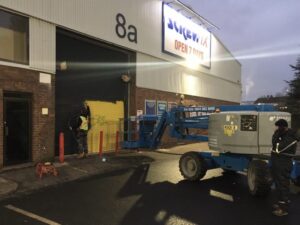
High-reach access and safe working at height
Commercial sites often require access solutions such as:
- Mobile tower scaffolds
- MEWPs (scissor lifts and boom lifts)
- Fixed scaffolding or temporary works
- Specialist access for voids, stair cores and atriums
In the UK, working at height must be properly planned and supervised under the Work at Height Regulations. Competent contractors build access planning into the programme — including rescue plans where relevant — rather than “figuring it out on the day”.
Dust-controlled preparation and hygiene-sensitive working
In occupied offices, retail environments, or education settings, dust control is non-negotiable. Best practice may involve:
- Mechanical sanding with extraction
- Segmented zones and staged working
- Low-odour, quick-curing products
- Careful scheduling around peak occupancy
The goal is simple: keep the business running without compromising standards.
Choosing the right paint system for different commercial environments
“Commercial” covers everything from a calm office corridor to a chemical-exposed plant room. The right system depends on wear, cleaning frequency, moisture exposure and substrate.
Offices and professional spaces: durable, low-disruption finishes
What matters most: low odour, fast turnaround, clean detailing, scuff resistance.
Typical considerations:
- Low-VOC paints to reduce lingering odours
- Scrub-resistant finishes in corridors and communal areas
- Consistent sheen levels to avoid patchiness under office lighting
- Careful cutting-in around glazing, trunking and fixtures
In office fit-outs, quality is often judged by the details: sharp lines, consistent coverage, and a finish that still looks fresh after months of use.
Retail and customer-facing units: brand accuracy and resilience
What matters most: colour matching, durability, speed of delivery, and a pristine finish under bright lighting.
Retail projects often require:
- Sample panels for colour and sheen approval
- Out-of-hours working to avoid trading disruption
- Fast-drying systems for tight refit windows
- Robust coatings for high-contact zones (queues, POS areas, fitting rooms)
Small imperfections show quickly in retail lighting. A contractor used to retail work will plan around this from the start.
Warehouses and industrial premises: performance over perfection
What matters most: abrasion resistance, cleanability, corrosion protection, and safe access.
Industrial environments introduce:
- Dust and grime that require thorough degreasing
- Steelwork needing anti-corrosion primers and compatible topcoats
- High-level painting (roof steels, gantries, services)
- Floor coating interfaces (where wall/floor junctions must be sealed cleanly)
Where steel protection is required, best practice aligns with recognised corrosion protection principles (such as those set out in ISO 12944), ensuring the coating system matches the environment’s corrosion category and expected service life.
Kitchens, wash areas and healthcare-type environments: hygiene and moisture control
What matters most: cleanability, mould resistance, moisture tolerance, and compliance with site hygiene protocols.
These areas may require:
- Moisture-tolerant coatings
- Surfaces that withstand frequent cleaning
- Careful sealing of joints and penetrations
- Strict control of dust, odours and access during works
Here, process and containment are just as important as the paint.
Exteriors and building envelopes: weathering and substrate compatibility
What matters most: preparation, breathability, and protection from rain, UV and pollution.
Exterior systems can involve:
- Masonry paints compatible with the substrate (including breathable options where needed)
- Treatments for algae/mould where exposure is high
- Repairs to cracks and failed sealants before coating
- Safe access planning for façades and elevations
A strong external finish starts long before paint is applied: moisture issues and surface defects must be resolved, not hidden.
Minimising disruption: how good contractors keep businesses operating
Most businesses can’t “close for painting”. The difference between a stressful project and a smooth one is often programme management.
Professional commercial painting services typically reduce disruption through:
- Phased working (zone-by-zone delivery, agreed handover points)
- Out-of-hours and weekend shifts where required
- Noise and dust control (including dust extraction and containment)
- Fast-curing systems that reduce downtime
- Clear daily communication (what’s happening, where, and what’s next)
- Site etiquette aligned to B2B environments (security, cleanliness, respect for occupants)
For multi-site clients, consistency matters. A repeatable method and standard finish across locations protects brand presentation and simplifies maintenance.
What drives quality and cost in commercial painting?
Cost in commercial painting is rarely about “how many litres of paint”. It’s driven by risk, access and preparation.
Key cost factors include:
- Access requirements: scaffolding, MEWPs, permits, logistics
- Surface condition: repairs, stripping, stabilisation, anti-corrosion work
- Coating performance: higher-spec systems, primers, durability requirements
- Programme constraints: out-of-hours work, accelerated schedules
- Site controls: segregation, dust management, security protocols
A practical way to evaluate value is to consider the life-cycle cost: a finish that lasts longer, cleans better and needs fewer touch-ups can reduce total spend and disruption over time.
A decision-maker’s checklist: how to brief a commercial painting contractor
A clear brief leads to a more accurate programme and fewer surprises. Before requesting a proposal, gather:
- Areas to be painted (including ceilings, woodwork, metalwork, externals)
- Operating hours and constraints (noise, access, customer flow)
- Any compliance requirements (fire protection areas, hygiene zones)
- Known defects (damp, flaking paint, rusting steelwork, cracking)
- Preferred timing (phasing, handover dates, blackout periods)
- Expectations on durability (traffic levels, cleaning regime, longevity goals)
- Approval process (sample areas, colour sign-off, snagging thresholds)
A contractor with strong commercial experience will translate this into a practical specification and delivery plan, not just a price.
Commercial painting FAQs
How long do commercial painting projects take?
Timescales depend on area size, access needs, and how much preparation is required. A well-run contractor will provide a phased programme so areas can be handed back progressively, rather than waiting for the entire project to finish.
Can commercial painting be done while we stay open?
Yes, with the right controls. Phasing, out-of-hours working, dust management and low-odour products allow many offices and retail spaces to keep operating. The key is planning traffic routes, occupancy, and cure times in advance.
What’s the difference between domestic and commercial painting?
Commercial painting typically involves larger areas, tighter programmes, more complex access, and greater emphasis on safety documentation and operational continuity. Commercial coatings may also be higher performance to withstand heavier wear and cleaning.
How often should business premises be repainted?
There isn’t a single rule. High-traffic corridors and customer areas may need refreshing more frequently than private offices or low-use rooms. Externals depend on exposure and substrate condition. A planned maintenance approach can target the most vulnerable areas first.
Is airless spraying always the best method?
Not always. Airless spraying is excellent for large, open surfaces and consistent finishes, but it demands meticulous masking and controlled conditions. For detailed areas, occupied spaces, or tight zones, traditional brush-and-roller work can be more appropriate.
What should we expect from professional commercial painting services?
At minimum: a survey-led specification, clear programme, robust preparation, safe access planning, quality control, and a clean handover process. The finish should look good and perform reliably, not just on day one.
Where Inter-City fits: a modern, controlled approach to commercial painting
For businesses, the best outcomes come from contractors who treat painting as part of asset management: survey first, specify properly, control risk, and deliver consistently. Inter-City’s approach reflects that reality, combining planned access, professional preparation standards, and efficient application methods (including airless spraying and high-reach solutions) to deliver high-quality finishes with minimal disruption.
Commercial painting done right is measurable: fewer snags, fewer call-backs, smoother delivery and a finish that continues to represent your premises well long after the last coat has dried.
If you’re planning a refurbishment, rebrand, or planned maintenance cycle, investing in properly specified commercial painting services is one of the most effective ways to protect your building, support day-to-day operations, and elevate the experience of everyone who uses the space.