

For large businesses, warehouses and industrial buildings, graffiti is rarely just a cosmetic issue. It can make a site look unmanaged, undermine customer confidence and create the impression that standards have slipped. Just as importantly, public guidance in the UK consistently treats fast removal as one of the most effective ways to reduce repeat tagging, because visible graffiti can encourage further incidents.
That is why professional graffiti removal services should be seen as part of planned property maintenance, not an afterthought. Done properly, commercial graffiti removal restores the surface without spreading the problem or damaging the substrate. Done badly, it can leave ghosting, strip coatings, drive paint deeper into porous masonry or create unnecessary safety and environmental risks. Historic England, for example, warns that inexpert cleaning can cause significant damage and visual disfigurement.
Why graffiti matters more than many businesses realise
It affects perception immediately
First impressions matter in industrial and commercial settings just as much as they do in retail. A tagged service yard, loading bay wall or customer-facing façade can suggest weak site control, even when operations inside are excellent. Consequently, graffiti can damage confidence among clients, visitors, tenants and staff long before anyone steps through the door.
In practice, the issue is often broader than appearance. Graffiti can sit across branded cladding, entrances, shutters, wayfinding zones and perimeter walls. As a result, it can dilute corporate presentation and make a well-run facility look neglected.
It can create operational and reputational risk
Some graffiti is simply nuisance vandalism. However, offensive, abusive or targeted markings can escalate quickly into a reputational issue, especially if they are visible to the public or workforce. Meanwhile, repeated tagging can signal weak deterrence, which is why fast response matters for larger sites with long perimeter lines or exposed service elevations. UK council guidance repeatedly stresses that quick removal helps deter repeat attacks.
What professional graffiti removal services actually involve
Surface first, product second
The best graffiti removal contractors do not start with a chemical drum or a pressure washer. They start with the substrate. Brick, concrete, powder-coated cladding, steel shutters, painted blockwork and glazed surfaces all respond differently, so the removal method must match both the paint media and the underlying material.
This matters because graffiti often behaves differently from one site to another. Aerosol paint on sealed metal may sit largely on the surface. The same paint on porous brick can penetrate quickly, especially in warm conditions. Therefore, the right method depends on the age of the graffiti, the porosity of the surface, previous coatings and the standard of finish required.
A professional contractor uses the least aggressive effective method
A good industrial graffiti removal programme aims for the least aggressive method that still achieves the result. Depending on the surface, that may involve specialist cleaning chemicals, hot water, steam cleaning, controlled pressure washing, abrasive cleaning, localised overcoating or a combination of methods. Historic England advises that understanding both the building material and the graffiti media is essential for safe treatment. Meanwhile, the Water Jetting Association’s Purple Code covers the safe use of pressure washers, including cold water, hot water, steam and chemical pressure washing up to 207 bar.
Intercity’s own approach reflects this surface-led model. Its graffiti removal work draws on pressure cleaning, steam cleaning and shot blasting where appropriate, with the method selected to suit the substrate rather than forcing every job into the same process.
Matching the method to the substrate
Brick, stone and concrete
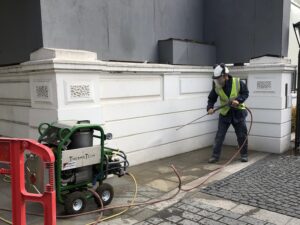
Porous materials need caution. On brick, stone and some concrete finishes, aggressive cleaning can leave a visible patch, erode the face or push pigment deeper into the surface. Therefore, brick graffiti removal and masonry cleaning should normally begin with testing in a discreet area, followed by controlled removal using a method that balances cleaning power with surface preservation.
For more sensitive façades, steam-based systems can be a better option than aggressive washing because they reduce mechanical impact while still lifting contaminants. That is particularly relevant where the same contractor may also need to clean the wider façade and not just the tag itself. Historic England specifically warns against inexpert treatment on masonry and similar surfaces. Intercity also notes that DOFF-style steam cleaning is effective on brick and stone while limiting damage risk.
Painted cladding, roller shutters and steel doors
On coated metal, the challenge is different. The graffiti may come off relatively easily, but the original finish can soften, dull or lift if the wrong solvent or pressure is used. That is why cladding graffiti removal often requires lower-pressure washing, careful chemical selection and strict control of dwell time.
If the existing coating is already weak, the contractor may recommend localised repainting after removal instead of repeated aggressive cleaning. This is often the most economical route for roller shutters, steel doors and previously painted service areas, because the finish matters as much as the tag removal.
Large walls and repeat-hit areas
For larger industrial walls, perimeter elevations and service yards, a one-off clean may not be enough. If the site experiences repeat attacks, the contractor should look at future maintenance as well as current removal. In those cases, anti-graffiti coatings, planned overcoating or wider façade cleaning can make far more sense than treating each incident in isolation.
Why trained graffiti removal contractors matter
Graffiti removal may look straightforward from the ground, but it often involves hazardous substances, work at height, live traffic routes, wet surfaces and electrical risk. HSE guidance on cleaning highlights the need to control hazardous substances under COSHH, while its work at height guidance notes that falls from height remain one of the biggest causes of workplace fatalities and major injuries.
Water-based removal adds another layer of risk. HSE has published a case in which a worker received a 240-volt electric shock while using a pressure water washing machine, with the investigation identifying failures in equipment maintenance and safe systems of work. Therefore, graffiti removal services on industrial sites should never be treated as a basic wash-down.
A competent contractor should be able to show:
-
surface assessment and test patches
-
RAMS suited to the building and access method
-
COSHH controls for removers, cleaners and coatings
-
safe work at height planning where required
-
protection for glazing, signage, air intakes and adjacent finishes
-
wastewater and run-off controls
Environmental control matters as well. Graffiti wash water may contain paint residue, solvents, cleaning chemicals and other pollutants. In England, discharging contaminated wastewater to surface water or the ground can require an environmental permit, and businesses should use appropriate pollution prevention measures. The Environment Agency also states that, where reasonable, wastewater should go to the public foul sewer rather than to surface water.
Why fast commercial graffiti removal usually saves money
Quick response is not only about appearance. It is often the cheapest way to protect the building fabric and stop the problem growing. Councils including Wandsworth and Bristol explicitly advise that quick removal helps prevent repeat graffiti, with Bristol stating that removal within the first 24 hours, where possible, is the best way to stop it happening again.
There is also a practical maintenance benefit. Fresh graffiti generally sits closer to the surface, which means contractors may achieve a cleaner result with less intervention. By contrast, old tags on porous masonry often need more labour, more specialist chemistry or partial overcoating to restore a uniform finish.
For businesses managing large estates, the savings add up in three ways:
-
less need for full wall repainting
-
lower risk of repeat tagging on the same area
-
reduced downtime and fewer complaints from staff, visitors or tenants
Can anti-graffiti coatings help?
Yes, in the right location. Anti-graffiti coatings do not stop vandals tagging a wall, but they can make future removal faster and less invasive. That can be especially valuable on service yards, perimeter walls, customer access routes and repeat-hit cladding panels.
However, the coating has to suit the surface and the appearance standard. On modern industrial buildings, a permanent or long-life protective coating may make sense on frequently attacked areas. On sensitive masonry, the decision needs more care, because breathability, finish and future cleaning all matter. For this reason, experienced contractors assess both the surface and the pattern of attacks before recommending a protection strategy. Historic England’s guidance on graffiti prevention also stresses the value of putting physical and social measures in place after removal to reduce recurrence.
How to choose the right graffiti removal service
When comparing graffiti removal services, look beyond speed and price. A reliable contractor should be able to explain not just how they will remove the tag, but how they will protect the surface and avoid secondary damage.
A strong brief should include:
-
the exact substrate, for example brick, cladding, concrete or coated steel
-
whether the area is public facing, operational or high level
-
whether a like-for-like finish is required after removal
-
whether the site suffers repeat attacks
-
whether anti-graffiti coatings or repainting may form part of the solution
Intercity is well placed in this space because its capability extends beyond simple cleaning. It can combine graffiti removal with pressure cleaning, steam cleaning, shot blasting and protective coatings, which gives clients a more complete maintenance response rather than a temporary cosmetic fix.
People Also Ask
What is the best method for removing graffiti from brick?
The best method depends on the brick type, the paint used and how deeply it has penetrated. In most cases, contractors start with test patches and then use the least aggressive method that will remove the graffiti without scarring the face of the brick.
Can pressure washing remove graffiti?
Yes, sometimes. However, pressure washing is only one tool. On hard surfaces it can work well, but on porous or delicate surfaces it can spread the paint, damage the substrate or leave patching if used incorrectly.
How quickly should a business remove graffiti?
As quickly as practical. UK council guidance often recommends rapid removal, and Bristol specifically says that removal within 24 hours, where possible, is one of the best ways to prevent repeat tagging.
Should businesses use anti-graffiti coatings?
Often yes, especially on repeat-hit walls, shutters and cladding. The right coating can reduce future cleaning time and help preserve the original finish, although the system must suit the surface and the operating environment.
Protecting your business image for the long term
Graffiti is a visibility problem, a maintenance problem and, in some cases, a risk problem. Therefore, the best response is not simply to remove the paint as fast as possible. It is to restore the surface safely, protect the asset and put measures in place that reduce the chance of repeat damage.
That is why professional graffiti removal services deliver the most value when they combine rapid response with surface expertise, safe systems of work and a long-term protection plan. Intercity’s experience across cleaning, blasting and coatings makes that kind of joined-up approach possible, which is exactly what larger commercial and industrial sites need when appearance, safety and asset condition all matter.